
Leaving Venice For The Unknown
No sooner had we begun to enjoy Venice, St. Mark’s Square, innumerable bridges, incredible food – especially vongole in any meal combination – than it was time to press on to a rental house near Geneva prior to that dreaded event, boarding school. Venice train station was complete chaos except to Mama Riva and dad. They knew what was what, who was in charge, who to tip, who to command. Like a royal entourage, we were escorted to the Wagon Lits carriage, shown our three adjoining cabins and a half hour before the train left the station, a conductor, having an argument with my father over times and train changes, finally kept promising that everything would be perfect, “Non e una probleme signore.” With that promise, dad paid him and we settled in. Being August the train was packed, everyone had luggage for which there was no room in the overheads. The carriageway had suitcases lined all the way up and down the aisle and, when we went to walk the length of the train, so did every carriage. It was only when I wanted to use the toilet at the end of the car that I found out it too was stacked with luggage.
I really had to go. I was a kid. The train pulled into Verona station and dad took me off, quick marched to the gents. Standing before a urinal with maybe 20 men, and not used to public urination, I was put off until dad commanded, “Now. There’s no time.” Urinating on command wasn’t easy but somehow I managed it. Soon after, we departed Verona for Milan. Somehow, our carriage was just as full as before. When Mike then had to go, dad explained that the next stop was Milan, an hour away, and Mike would have to make do with a coke bottle. In our cabin, dad and I turned out backs as Mike peed in the bottle, then asking, “What do I do with it?” Dad opened the small upper window and Mike dropped it out. The bottle broke up under the train and dad told Mike that next time to throw it further. When the train pulled into Milan, our carriage was uncoupled, then shunted forwards and backwards, and finally coupled with the Simplon Express. Leaving Milan, along with all the crowds and their luggage, made the train seem empty, comfortable, and faster somehow. When we reached the start of the mountains the train slowed, rocked and dad told us we had another 4 hours for Geneva.
The comparison of Italy to Switzerland was startling. Italy was warm, inviting, grimy, busy, vibrant, and sort of broken in places. Switzerland was immediately cleaner, calmer, quiet and everything worked – perfect but did not seem as welcoming. The guard who came aboard was taciturn, but polite. My mother’s French, coupled with Mama Riva’s and dad’s won him over quickly. We may have appeared American but we were civilized, not rubes. Right then and there I came to realize that the Swiss were friendly if withdrawn until they knew you, polite but wary of your bad manners, always scrupulous with money and debts, but most of all liberal. In all my time in Switzerland and ever since, I have yet to encounter prejudice that is so open in most other countries. Perhaps it is hidden at times in Switzerland, but it is hidden because the person knows it is not morally acceptable. I prefer that to blatant prejudice when it comes to an easier life.
Take the issue of Switzerland and the Jews escaping across from Germany in WWII. Switzerland had neutrality laws requiring any illegal immigrant be returned. And the police did exactly that if they apprehended a runaway. But for decades I met men and women working on Alpine farms who were never returned simply because they never were turned into the Police. Lawbreakers? Technically. My mother made friends with a woman of her age in the ‘80s, still with a Berlin Jewish accent, who still spoke of her family who died in a Concentration camp and thanked the Swiss family who secretly took her in as a teen.
Oh, and one more thing about the Swiss and the so-called Jewish money. Marlene, Robbie Lantz (the great theatrical agent), Billy Wilder, and others all affirmed that even in the early ‘30s no Jew would ever, ever, put money in Switzerland because they were sure the Nazis would walk over Switzerland. They put their money in Paris with the Rothchilds and in Shanghai Jewish banks – and lost everything. The German names on secret deposits in Switzerland were, no doubt, Germans’ accounts, but unlikely to be Jewish. Was there anti-Semitism in eastern Switzerland, in those banks? Yes, there is a history of shame the Swiss are quite open about. But the notion that good people, especially Alpine people turned their backs is not true. Just ask the OSS and the clandestine Swiss help they got in the OSS HQ in Bern.
Arriving in Geneva was a bit of an ordeal. Dad, desperate to show mom and Mama Riva the beauty of the city, had arranged with American Express to handle the luggage and take it to the house he, Noel Coward, and Marlene had found and rented for the month in Jussy l’Eglise to the southeast, on the southern side of Lake Geneva. Once the luggage left, he marched us down the rue du Rhone towards the bridge from where we could see the Jet d’Eau, a fountain almost 500 feet high. The lake was blue, the water column sparking, the backdrop Mont Blanc mountain imposing, the flowers decorating the bridge ramparts... picture postcard perfect. Mom’s reaction? She hailed a cab and we piled in, off to Jussy l’Eglise. Mom was nervous. She knew her mother was waiting, a telegram delivered to the train as we passed into Switzerland, told her the house was ready, that Massy was already there. Mom had hoped for a few days before the queen would arrive.
Mom’s relationship with her mother was always that of queen and dutiful offspring. As Walter Matthau once commented (and later also told Michael in Hollywood), “Living under that shadow is unhealthy.” That said, mom never neglected her duty to her mother, even if she lamented the lack of true mother-daughter love.
Jusy l’Eglise was a small, sleepy village with a central square with a boules court, a bar-cafe and a church. Our house was down a lane and we arrived in time for the American Express van to arrive with the luggage, Marlene standing in the open front door to welcome us and bark orders to the luggage men, on whose room was whose, up one flight, two flights up for Michael and me under the eaves.
Mike and I were only to spend two weeks there before boarding schools, while Paul, David, mama, mom and dad would stay another month while dad found suitable rental for the family. By this time, Mike and I weren’t sure where we were or what was our fate. Marlene would come each day, early, from her hotel in Geneva (the Beau Rivage, always a favorite of hers), and took it upon herself to become a nanny for David. For years afterwards she would claim that she, and she alone, had taught David to walk. As Mike and I and Dad had worked on that for some weeks, we didn’t mind her claim. Mom was okay too, as it kept Massy busy while mom prepared clothing and the schools’ inventory list requirements for school trunks.
Mike and I would go off to the town square and watch lunchtime adults playing “petanque” or boules. Like many such pastimes, when you play, you cannot think of anything else and as such boules is an escape sport, much like curling for which the Swiss also have a passion. The cafe didn’t have Coke so we learned to ask for lemonade. A glass with a half inch of yellow liquid was placed on the table, with a bottle of soda water and a bowl of sugar with a long-handled spoon. Do it yourself refreshment or, as we came to appreciate, do it yourself as you want it to taste drink. I am not sure you can get served this way anymore in this pre-packaged world, infecting even the Swiss.
At the start of the fourth day a cab pulled up outside. Mike and I knew something was wrong as mom, dad and Marlene were nervous all morning. Dad paid the driver, formally saying hello to the woman who got out. A small woman, carefully dressed, prim and proper glanced up the entrance steps at Marlene and waited to be greeted. All she got was a command, “Come Liesel...” as Marlene turned and went back inside. Dad told Mike and I to go watch boules.
When we dared go back around dinnertime, we were introduced to our great aunt Liesel, Marlene’s sister who no one in the family had seen since 1946. It turned out that Marlene had refused a formal invitation to visit Liesel’s family, “those Nazis,” when she toured Germany in 1960, two years earlier.
My great aunt was a sorrowful woman, no spark of humor, always on the verge of tears or subservience to Marlene, her younger sister. Mom tried to engage in conversation but Marlene would stamp on any familiarity immediately. Dad said nothing. Paul and David, as young kids do, sensed the tension and were extra invisible. Then a strange thing happened. After lunch one day Mike and I cleared dishes to the kitchen and before we could do our chores of dishwashing, Liesel seemed to find the bravery, took mom’s apron off the back of the kitchen door, and set about making soapy water and indicated to us to help wash and dry. She rolled up her sleeves and we got to work.
On her left forearm were numbers. Stupid kid that I was I asked how she had gotten them. Mom came up behind us and commanded, in German, “Tell them.” Liesel’s soft voice trembled and, in broken English, she said that her husband where he worked had been made to get them near the end of the war. She looked at mom, pleadingly I thought. Mom looked stern, as if Liesel had done something terrible. Mom explained, “Her husband worked for the Nazis in a terrible place, a death camp, and they pretended to be prisoners,” she pointed to the arm.
Liesel added, “So we would not get shot by the soldiers coming. Meine schwester saved me.”
Mom ushered Mike and I from the room and shut the door. Now, my mother only speaks hochdeutsch, the German of the nobility in Berlin of her family from the time she was born. There’s a haughtiness about hochdeutsch that commands respect and authority, much like the British Queen’s accent does. Liesel’s responses to mom’s lecture was a succession of yeses, but no other responses. Years later mom explained that she told Liesel that she should never, ever, pretend she didn’t know that the concentration camp her Nazi husband worked at, was not a notorious center for the Holocaust. Mom had met Liesel and her husband and son in 1946 in Berlin and was always angry that in Marlene’s familial desire to save her sister and young son, “that Nazi husband had also been saved.”
All of which, even to me back then, struck me as strange that she had even been invited to come and visit. It was years before I learned the reason. A month earlier, Marlene had been diagnosed with cervical cancer by Dr. de Wattville in Geneva, perhaps the finest gynecologist in the world at the time, and was told that a radical treatment might work, might not. Either way, Marlene’s days might have been numbered and a last visit by her sister, without her family, had been arranged for Marlene’s benefit. In the time Liesel was with us, a few days, I never saw any reconciliation. Marlene’s intellect and memory simply washed away any hope for the timid, “dormouse” character of Liesel. “Dormouse” was dad’s description. Thirty years later we found the x-ray of de Watteville’s treatment for the constantly performing Marlene: six small radium vials held by ribbons, ribbons sewn next to her cervix. The vials stayed there until the heart surgeon Dr. Michael Debakey removed them a decade later or else he could not operate safely. Marlene’s cancer was in total remission, of course. Woman of steel, character, spirit and constitution.
All too soon, it was off to school. Dad took Mike off to Le Rosey, in Rolle on the shore of Lake Geneva, or Lac Lemain as those not in Geneva call it. I didn’t see Mike for another two months. The next day it was my turn. We took a tram in Jussy l’Eglise into Geneva and got off, carrying my school trunk with dad on one side and me the other. Ecole Internationale de Geneva, or Ecolint, was a school of dozens of nationalities, full of business and diplomatic people living in Geneva. Things didn’t go well from the start. As we entered the school grounds, for 1,200 students, a larger school than I had ever seen, on the garage door was painted a sign, “Closez La Door.” Dad groaned and even with my 2 year, child’s, command of French knew this did not bode well. Things went downhill from here. Half a mile down a suburban road, a road on which I would get hit by a car next winter, a road with so many potholes I would crash a bike and smack my head with a ten day concussion in Spring... anyway down that road was a residence for the eighty boarding kids, old to young, where I was the youngest at 12. I was allocated a room for the year, with a German boy three years older who detested all Americans and took great pleasure of short-sheeting my bed every day and had questionable personal hygene. It is safe to say, I hated it from the first day, was perpetually lonely and, to make matters worse, was only allowed a half day off if my parents would visit on a Saturday and a day and a half, Saturday afternoon and Sunday ‘til 4pm, for parental “weekend” visits, providing my grade average didn’t dip. For the whole yar, I remember only managing six weekends. Mike got home every weekend.
Now, where was “home” since Jussy l’Eglise wasn’t long term? There’s something about my father’s ability to find just the perfect place, every time. Restaurants, picnics, sightseeing, homes, pretty much any location and dad’s radar would hone in and find that one perfect place, every time. To stay close to us two boys, while Paul and David didn’t need schools for another year, dad found a hillside home in Zone Franche (the border no-man’s land between Switzerland and France) in Grilly. 500 feet up from Lake Geneva, facing south and Mont Blanc’s snow topped peak shimmering away to the south across the lake, the house was, without a doubt, perfect.
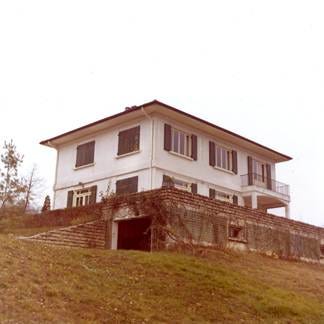
When holidays came, Mike and I would revel in the house, make airplane models in the basement garage, wait until the steep 2 mile road up the hill froze over in winter and then taboggan at breakneck speed down the whole length, hoping the “facteur” – postman – wasn’t slipping his wheels on the way up. We had some mighty crashes until dad caught us near the bottom of our run and asked us if we were nuts. Our true speed was not an illusion, it seems. Over the next few weeks he used to marvel we didn’t kill ourselves. I remember at the time reminding him that I got hit by a car in Geneva which smacked my left leg so hard it flew up, me following it, and landed ten yards away in someone’s garden. If that didn’t break anything, our taboggan slide should be safe enough. Somehow, he relented and we went back to daredevil runs.
Not having any money, and pocket money wasn’t part of either boarding school’s excess, when it came to Christmas, dad gave us each about $20 in cash on the proviso we didn’t waste it buying anything for him. Mike took Swiss francs as he was going to buy mom and the brothers something in Rolle. I took the French francs because I had seen an electrical shop in Gex, nearby, and knew that for years mom had wanted to make waffles, that American ideal breakfast. The waffle iron that the store in Gex had for sale made four heart-shaped waffles, thinner than American ones, but mom cried nevertheless on Christmas morning... and kept that waffle iron for the next 40 years until it wore out. What did Mike and I get Paul and David? We were hooked on French comic books. “Spirou” has the greatest adventures, especially when they discovered the perfect animal with a magical tail, the Marsupulami. We got the brothers comics stories, that we’d read to them (making up the English words sometimes), and small rubber toys of the Marsupulami. Over Christmas Mike built Paul a Marsupulami nest and tree, a perfect copy of the stories’ drawings. Mike’s theatrical abilities were strong, even back then.
To be honest, Mike and I didn’t know what was going on with our parent’s plans, but our time in Grilly was soon to be over for us. For me to join the family on a weekend, I took the train – yes all alone, I was 13 after all – from Geneva Cointrain stattion to Nyon. There a Deux Cheveaux van would wait for me, rear seats full of wine and produce mom had ordered, and we’d lean as the car swerved corners, winding narrow lanes and put-put up the hill to the house. The driver, a jovial fellow in a green work jacket, made me speak French, the Gauloise drooping from his lips as he sped along. If you haven’t ever been in a Deux Cheveaux car, you perhaps will be excused from not smiling at the memory. Anyone who has bounced along in a car designed for French roads, the famous “chaussée déformée” – cars in the ‘60s and ‘70s in France had suspension designed to soak up the terrible potholed roads – anyone who’s had this experience remembers it perfectly. No car was better at it than the Deux Cheveaux.
After enduring another term at school, Easter holidays loomed and mom and dad realized perhaps it would be better to escape to the sun. What Mike and I didn’t realize was that we never were to see Grilly again... after Easter holidays and then the spring terms, we found ourselves being loaded onto flights from Geneva to London. I saw Grilly again on my honeymoon with Sandy nine years later... it was still as magnificent a setting as I remembered.
So, for Easter break in ‘63, all 4 weeks, Marlene prevailed on friends, the Mullions, to loan us their villa in the south of Spain in Guadalmina. We flew into Gibraltar – already an adventure since the short runway was a challenge for the pilots – and then the family joined up, packed into a small Seat taxi, luggage piled and roped on top, and set out for the border into Spain, through the Frontiera, onto a partly paved road, cork trucks inching along, blocking the way, for an hour ‘til we came to an oasis, a fabulous resort called Golf Hotel Guadalmina. There was a pool, a great beach, a golf course, tennis courts, everything was green and tropical and the Mullion’s villa had servants, a green lawn, a veranda and a cook! What I wasn’t to know was that, just a few villas away, I would meet my wife Sandra, whose family were one of the first to buy a villa there.
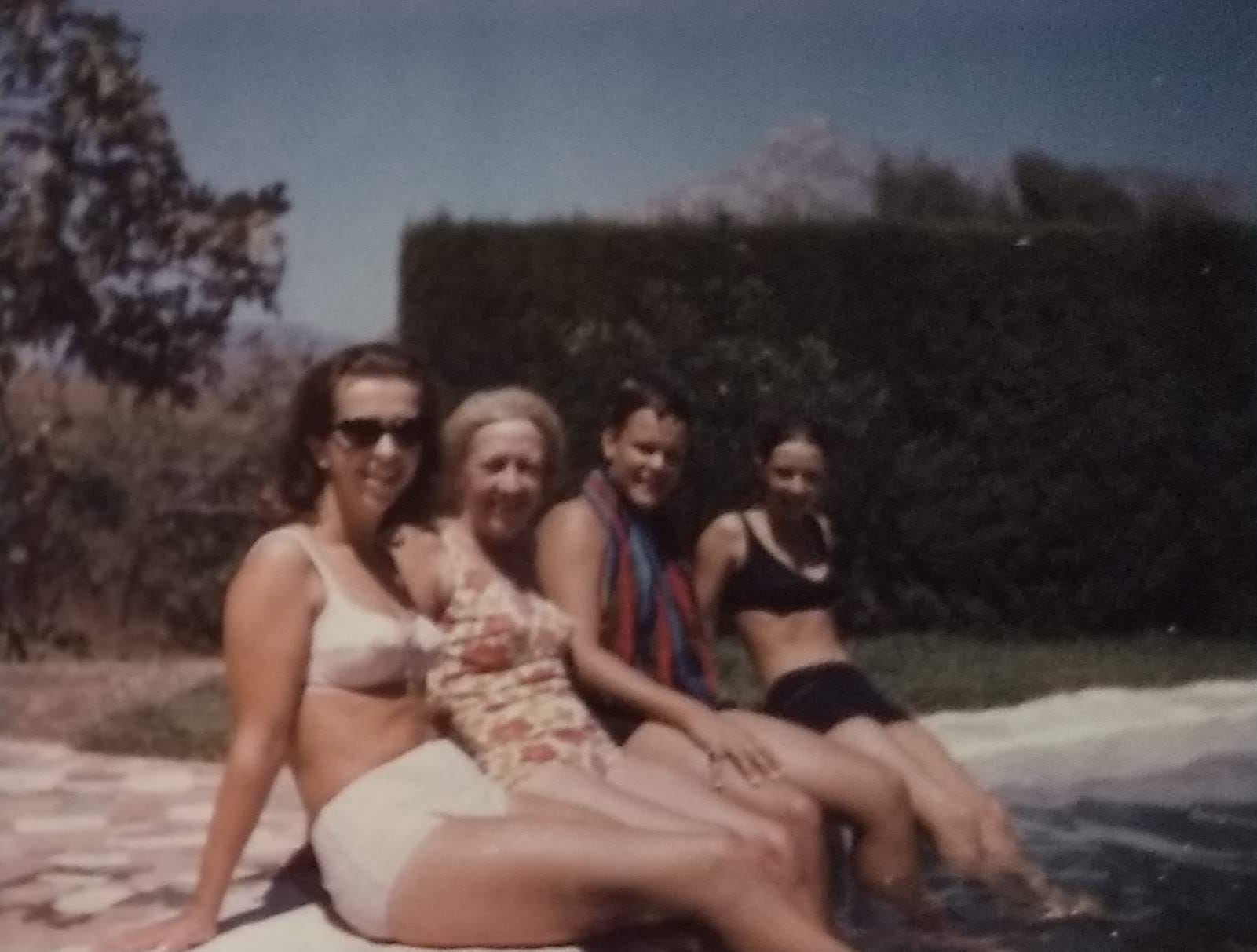
There’s an interim period for boys, perhaps for girls too, where sex isn’t the driving force but opposite companionship is. Somehow the non-competitive nature of a friendship with the opposite sex allows, especially at the age of 13, a bonding which may, or may not, develop later into the physical. Now, that does not mean that I wasn’t admiring her smile and physique. I was, but there was no lust to push anything further. We grew as friends, dated over the next 9 years, on and off, had adventures, and finally I realized, and proposed, by saying, “I think we should get married, don’t you?” Standing in a centuries-old Beech wood in 1972, thankfully she agreed.
Now, in Guadalmina, if you ask me what we did, I cannot tell you, it’s all unfocussed. Swimming, yes. Playing tennis? Sure, or trying to. Walking, generally playing, all the time. Oh, and Monopoly, yes, Monopoly -- Michael, Sandra, Sandy’s older sister Moira, and me... Christopher Garand had taught Mike and I well. Didn’t matter who won, we had fun. Half child, half young adult, I inched my way forward, awkwardly, into a lifelong friendship.
The Costa del Sol, on which Guadalmina was the jewel which attracted the rich and famous over the next decade, which then created the need for a fancier Marbella Club, and a host of major hotels – the Costa del Sol was the best holiday coast in Europe for decades. During its heyday, especially the mid-’60s, the resorts were the jet set’s playground long before they built Puerto Banus for the mega-yachts. Sandy and I would, from when we were 16, spend most nights at Pepe Moreno’s, dancing alongside half the celebrities in rock and films. Sean Connery (the only Bond), Cordobes, Jeanne Moreau, Alain Delon, Teddy Kennedy, Monica Vitti, Gunther Sachs, and Mick Jagger made Pepe’s theirs most nights. Aged 16, Sandy and I would stay ‘til gone 2am.
Before that first holiday in Guadalmina was over, dad left for London.
When I went back for the final two weeks at Ecolint, I borrowed a friend’s bike to go from school to the residence. There were times of the day that the road was dangerous. Swiss kids used to challenge the boarders on foot, bike chains whipping and causing welts and promising worse if you could not run away fast enough. The bike was a safety measure for me. I was tired of being accosted and robbed. The problem was that the road had potholes after the harsh winter and the bike went over, at full speed. The only thing to hit the pavement was my head. Picking myself up, seeing the Swiss kids approaching, I peddled as fast as I could to the boarding house. I went to bed and my roommate later called the house teacher because he could not wake me. They took me to the school infirmary and there I remained for a few days. On the second day, head aching, mom came to call and made them take me for an X-ray which they thought unnecessary. The police came and wanted to know if I had stolen the bike. I told the name of the kid who said I could borrow it. The next day the kid’s parents came back to explain that they were angry with him, as he had not told them he had lent it to me. The police closed the case. Ecolint never did anything about the street fights with the poor boarding students.
That was enough for mom, she told dad that his experiment for Michael was over and that I needed to change schools. I stayed at the boarding house for another week, now mostly empty as students had left for the summer and then one morning I was handed a plane ticket for the next day, July 6th and coldly told to be ready to leave the next morning. “Faite vos valises, depart a huit heure.” I read the ticket, London. Where were mom and dad? As I left the next morning, I was handed three letters, with cash, that mom had posted days ago, which explained that they had moved to London and found an artist’s house to rent on a street called Frognal in Hampstead, and that Mike and I would spend the summer there.
Mom apologized I had had to wait after Ecolint closed for the summer because Michael’s school only closed July 5th.
Let me explain travel in ‘63 in Europe. There was no security control for check in, you gave them your baggage, paid the excess weight for the school trunk, and walked through passport control, got your passport stamped and waited looking out the glass windows at the plane, a four engine Vanguard of British European Airways, as it was loaded. You waited to see your school trunk go up a conveyor into the belly of the plane, watched as the co-pilot did his visual inspection, as a tanker fueled the wing tanks, and, never least, admired the crisp uniformed stewardesses climb the stairs to enter the plane. Half an hour later the flight was called. Mike and I, having met up in the waiting area, boarded the 90 minute flight to London Heathrow.
Michael had instructions and money from mom and dad and, after clearing H.M. customs (everything was always opened and inspected back then), we asked a porter for help. Now, you may think it grand to have a porter to help with the luggage. Back then there were no airport trollies, no luggage with wheels. You carried everything yourself or hired a porter, prices in France and England posted per bag, no guesswork required. As Mike and I each had a trunk and flight bags, he told me to pay the porter while he made sure the London taxi carefully stowed our trunks. London cabs back then had an open compartment next to the driver. No door, just a platform and straps for luggage. Mike and I sat in the back and were whisked off to Frognal, a new adventure about to begin.
It was a little more frightening for me since I was going to an unknown house, not really a home, and after the summer I would be going to a new school which, frankly, Michael didn’t paint with very favorable tales of hazing, something called pink-belly, and twice a year you had to pack up all your stuff and move the entire school to a place called Gstaad in the Alps to go skiing. For me, it was one thing to careen down an icy road on my belly on a sled, quite another to try skiing again. I tried it, once aged 12, at Col de la Faucille, the mountain pass in the Jura mountains above Grilly over Christmas and fell twenty times in one afternoon. As a tall kid, not very athletic, I was brave except when it came to balance. I had almost none. It would take years before I figured out skiing and became a passionate devotee.
Dad explained that next year there would be no family weekend visits, we’d have to fly to London for Christmas and Easter and, presumably, summer. It was time to be grown up and knuckle down at “one of the finest schools in the world.” For a guy who went to school in Detroit (or so we thought at the time), Mike and I wanted to know how he judged Le Rosey, but we never asked. To actually give us a summer holiday, as a family, dad rented a Hillman station wagon and we drove north to Scotland. Now, unless people have been to Scotland, good weather or bad, rain or shine, you cannot appreciate the vast beauty of the place. Okay, as a driving tour, parts were downright depressing, like Paisley and Glasgow, but Loch Lomand, the Highlands for long walks, a small village called Tully for fishing, Pitlochry where I saw my first salmon ladder going around the dam on the river Tay, and then on to Edinburugh and the Military Tattoo, which was spectacular echoing off the castle ramparts, and, not least, a little surprise dad had for me.
More than Mike, I loved fishing. On the East Coast of Scotland there was a small fishing village of Anstruther Harbour. It had a picturesque harbor filled with small fishing craft. Dad had talked to two men on one boat and got them to take me out the next morning, leaving at 5am, for haddock or cod fishing. I was given an oilskin and extra sweater, “It’ll be cold laddie” as I was handed over to the two fishermen of a wet, slippery stone pier the next morning. Dad was into these sorts of adventures and assumed I would be too. I was frightened but excited. The men were careful and kind, I remember their smiles to this day. To start their little engine, which was amidship, they used their home-rolled cigarettes held up to a little engine pipe which popped and the chug-chug-chug got going. We made our way into the open North Sea.
Fishing for cod and haddock had nothing to do with rod and reel. I was given a wooden block of wood around which was wound large hooks, each with a white feather attached, no barbs on any of them, and a lead weight at the very end. I was shown what to do, lower the weight, followed by the hooks and yards of white strong string until I got to a red ribbon. Then hold fast. The boat was drifting only, rocking in the swell, I was feeling slightly seasick in the bobbing boat but determined not to give in. The boat rocking was enough to make the hooks, 300’ lower down, bob up and down. My fingers were frozen but I felt the line in the crease of my forefinger and told them I thought I had one. “Wait a bit, ‘tis a good spot this one.” I did as I was told. Then, with their lines down as well, they nodded to each other and me too and we all started to pull up the line, not winding it on the wooden block, but hand over hand.
I pulled five fish aboard, never letting the line go slack because I knew that without barbs, the cod could dislodge the hooks if I let slack. To this day I always assumed they were cod, but they might have been haddock. The men never said, just promised my belly would be full at breakfast!
The five fish were flapping about in the boat and the men urgently told me, “Go ‘agin laddie!” I did as I was old. We fished for about two hours in that spot until there were no more on the line. The motor was primed again and we set off, crossing the harbor mouth and entering a small bay where the boat pulled up to buoy after buoy, raising traps and finding a few lobsters in each.
When we got back to the harbor it had turned warmer so I took off my oil slicker, waved at mom and dad and brothers on the wharf quay holding up a lobster and what I thought was my largest fish, maybe two feet long. Dad seemed genuinely pleased. He talked to the fishermen and they directed him to take my fish, not the lobster, to the bar where the quay met the town. We ate it for breakfast, the whole family, pan fried, fresh white bread, cuppas and my love of Scotland was cemented.
Driving south, we assumed the Scotland trip was over and we’d be going back to the house in Frognal. Instead, we pulled up in Thames Ditton and got aboard a Maidline Cruiser, this time a larger one, and set off on the Grand Union Canal for a week. Mike and I were the lock operators, we each had our own lock key, a wrench device to raise and lower the lock gate paddles. It was physical, fun, and, most importantly, the sun shone the whole time and the family really finished a great vacation. I asked Dad when or if we were going back to the house in Frognal and I remember his response, “Soon enough, your grandmother is coming.” Seems we needed – and got -- a happy family time before the pressure of mom’s mother would disrupt family life.
Late August Marlene arrived, staying at the Dorchester. Mike and I, properly attired with blue school blazers, were dropped off there a few times into her suite with her conductor Burt Bacharach playing the piano. He’d play us the songs be and Hal David had just written, telling us tales of Dionne Warwick’s magnificent voice. Dionne had been a singer in NY before we left Manhattan and Marlene had urged Burt to go “up into Harlem” to hear her sing.
In truth, Burt was always very kind to Mike and me then, and later on when he was marrying Angie Dickenson in Rome, and for decades after. Burt’s birthday was May 10, mine was May 11, so we’d usually exchange birthday wishes. However, and I would never have told him that his singing of his own songs was painful. He didn’t have the range, Hal David’s words seemed to stick in his raspy throat and, as wonderful as the songs were, his pride in singing them made Mike and I cringe a little. But we never showed it. His songs in the care of some of the world’s great pop stars were great, fun, and lord were they instantly popular. But compared to our tastes at the time? We were Beatles devotees... and Lulu and Aretha, Dusty and Leslie Gore... these set our blood going. A few years later, listening to Radio Luxembourg crackle through the distant airwaves in our dorm at school, we first heard the rolling Stones’ Satisfaction and were fully converted away from most melodic ballads. Burt’s great songs endure, of course, but teens want what teens need... and we wanted to get with the beat baby!
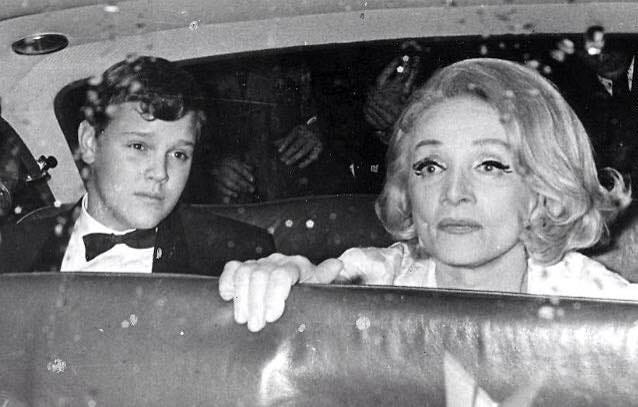
While mom got on with the business of Marlene, costumes, translating songs lyrics, bookings and producers, fees and negotiation – something mom would do for the next 25 years – Mike and I were mostly free before the looming deadline of a flight back to Switzerland. We loved movies. Lots of movies. Leicester Square, ten or so stops on the London Underground from Hampstead, was movie mecca. Lyons Corner House between Leicester Square and Piccadilly Circus had five floors of restaurants. On the ground floor was an eat-at counter. For two and six (two shillings and six pence) you could get a steak sandwich, dripping gravy. That left money for the movie house, first showing at 11:30, no matter what was on screen. There were five theaters in that area, we’d rotate through them all, usually seeing the same movie twice, always keeping just enough money for the Tube fare home. Some days we could buy an ice cream in a small tub with a wooden spoon (this was before English cinemas served popcorn).
Over the years, Mike and I saw great films and bad films in Leicester Square, it didn’t matter. Some were American imports, some were home made films, some Italian imports – Fellini, Mastroianni, Loren and Anita Ekberg. We loved the Lavender Hill Mob and Alphie, Billy Liar, Those Magnificent Men in their Flying Machines, Cat Ballou, and the Guns of Navarone. We attended the day after the premiere of Lawrence of Arabia and were destined to return five times in the following weeks. Anything James Bond, well how could you not see it again and again? The Hill with Connery was terrifying, as was Clockwork Orange.
Now, there were two films that we saw when they came out and went back several times, and then when they were re-released we saw them again and again. The Graduate held us spellbound, everything about it foreshadowed our very future. I was 17 and Mike at 19. You can imagine the impact. The other film, which I think I have seen at least once every two years since, was 2001 A Space Odyssey. In ‘88 when it was re-released, Mike, then 40, and I, then 38, sat in the front row of a cinema in LA, Mike was stoned on marijuana, and he did a running commentary on the effects and sets all the way through. It is no wonder he rose to the top of that profession.
While we’re speaking of London movies, we were invited to the premiere of Hawaii in Leicester Square in ‘67. Marlene was in town and, of course, we sat well behind her in the balcony. She sat up front, balcony front row, with the producer and actors, including Julie Andrews. That movie is seriously bad. So bad – and Marlene was never one to suffer fools lightly – that when Richard Harris playing a bible thumping priest falls into the water and sharks approached she stood up and yelled, “Get him!”
I watched Harris and the producer shrink in their seats while the audience applauded her critique.
Years before, when Mary Poppins came out , so good was Julie Andrews, mom wrote to congratulate her. Later, when the Sound of Music was released, mom’s relationship with Julie became more personal. Julie personally invited Mom and Marlene. Marlene couldn’t make it – mom was privately happy to avoid a possible spectacle -- so mom went to the gala and came back pronouncing the film was wonderful and that it would be the year’s number one hit. No none believed her, not even the papers. Mom was right of course. I know people who have gone to see it dozens of times – not even close to the number of times Mike and I have seen 2001, but still Sound of Music is one of the all time most popular.
Which brings me to a bit of Hollywood nonsense on the most popular film of all time rating. Forgetting television viewership numbers – since they are practically incalculable – let’s stop the nonsense of declaring “most popular of all time” by measuring dollars and cents; box office money. If you measure with actual audience numbers – the paying audience, no matter how much a ticket cost in whatever time period – then Gone With The Wind is still number 1. Star Wars comes close, as do Charlie Chaplin films, Ben Hur, Snow White, Cinderella, Jaws, ET, all the way down to Lawrence of Arabia, 2001 A Space Odessey, and a host of others including Goldfinger. Box office means nothing, except for the financial business of current movies on release. Titanic is a great film, but less than 10% of the viewers of Gone With The Wind. And I am not mentioning the Keystone Cops or Buster Keaton, millions of seats sold for 5 and 10 cents, moving images displayed on bed sheets, in barns, and homes across America in the Depression.
If you do not regularly watch TCM, you are missing out on really well crafted, thoroughly well written, exciting films. Me? Fred and Ginger rank right up there, along with anything with Henry Fonda, Barbara Stanwyck, Clark Gable, Hepburn and Tracy, Audrey Hepburn, Gary Cooper, Debbie Reynolds, John Wayne, Gregory Peck, Bergman, Monroe, Hayworth, Elizabeth Taylor, Doris Day, David Niven, and a host of others.
Marlene’s films? There are performances – in which she is untouchable even if the plots and scripts are awful – and then there are four rare acting roles in movies with sound: The Blue Angel, Judgment at Nuremberg, Witness for the Prosecution, and A Touch of Evil (the directors cut, not the shortened version). Nothing she ever did was a failure for her talents, even if the movie may have otherwise been less than successful. As for all her other films? She is the pivot, the centerpiece of talent for the other actors, costumiers, lighting gurus, cinematographers, and set designers. She always directed herself. And she was, truthfully, never the actress star. But a remarkable presence as a performer that was so unique it has never been equaled. She directed herself, modelled herself as needed for visuals and kept very still. As the great agent Robbie Lanz said, “Who knew in the ‘30s just how great she was? She never emoted, or moved. She made the camera and the audience’s eye go to her. She was decades ahead of her time.” I asked him what he thought of her performance in Destry Rides Again. “Every child needs to play hooky. She was having fun and it showed, and yet, 30 feet high, she was still Marlene. Quite a silly film, a total failure without her. All her films owed her.”